Monday, October 24, 2011

Das's Chickpea Salad

 
I never meant to threaten my housemate with a knife.

I was living at the time with a couple of Anglo women who studied too hard, and a Pakistani man named Das. Das had very regular habits. Every morning, he left for work in his little white car; every evening, he came home, parked in the driveway, stayed for an hour or two then, while we women headed back to our desks, he went to put in a few hours at a friend’s restaurant. On weekends, if we were lucky, he cooked.

One weekday I came home to what should have been an empty house. The driveway was empty, but to my alarm the front door was swinging open. I peeked in, and called ‘hello?’. There was no answer, so I called louder. Again, silence. Heart pounding, I stepped softly into the hallway, tiptoed to the kitchen and, being a silly young thing, grabbed a long knife. Then I crept around the house, checking each and every room – behind the doors, under the beds, the works – until I came, at last, to Das’s room. He wasn’t home; his car wasn’t in the driveway; he was at work.

But I thought I heard the sound of breathing.

So I crept in, knife raised high, only to find Das dozing on the bed. I shrieked, he opened his eyes and yelled, and I collapsed in hysterical giggles.

It turned out he’d felt sick at work. He’d left in a daze early, parked his car randomly up the street, staggered in the front door, and collapsed into bed, only to be woken by the knife wielding maniac that was me.

These days I’m older and wiser; I figure I’m the only person likely to be injured in a knife fight. So I keep my kitchen knives where they belong, and use them to chop vegetables and think of Das.

He was a terrific cook. I particularly remember eating industrial quantities of his chickpea salad, served warm. I still dream of it; mine, sadly, is never as good.

Chickpea salad is very simple, but it depends on two things. For one, I have never eaten a canned chickpea that hasn’t tasted tinny, so I cook my own from dried. If you don’t mind the tinny taste, you are welcome to use canned chickpeas, but for mealy chickpea perfection, cook them yourself.

The other is to chop the other vegetables neatly, chickpea sized or smaller. It makes the salad visually appealing, and it means that each mouthful is an explosion of different flavours.

Chaat masala is a spice mix for salads. Dried green mango and asafoetida give it sourness; and then about a dozen other spices just make it taste good! You can buy it at any Indian or Pakistani grocery store. It’s worth having a packet in your pantry just for this salad; I certainly do.

Das’s Chickpea Salad (Very Easily Multiplied!)

- 1 cup cooked chickpeas. If they are warm, so much the better.
- 2 medium carrots, diced small
- 1 celery heart, or 2 stalks celery
- 1 long cucumber
- a small bunch of coriander, chopped
- a hefty pinch of chaat masala
- the juice of a lemon

If you are using the celery heart, shred it crossways right up into the yellow leaves. If you are using celery stalks, dice them as small as the carrot.

Peel the cucumber entirely if the skin is coarse. Halve it lengthways. Cut out the seeds by slicing a shallow V and scraping them out. Dice the remaining flesh nice and small.

Chop the coriander coarsely.

Combine the chickpeas with the vegetables and the coriander. Dress with a generous amount of lemon juice, and sprinkle with a little chaat masala to taste. Mix well.

This makes enough for two or three lunches. In lieu of my mother’s chappatis – how I miss them! – I eat it with homemade unleavened bread made with buckwheat flour and sprinkled with nigella, or with fresh pita.

(Localish: chickpeas from Horsham area; carrots, coriander, lemons. Not so local: celery, salt, chaat masala.)

Monday, October 17, 2011

Clove Scented Onions


My two favourite restaurant names are the New Wind, which serves Thai and Vietnamese food to its lucky patrons in Windsor; and the Sha Tin, serving up quality Chinese takeaway in Heathmont. Lately, after a spate of particularly bad cooking, I thought of the latter; it felt like more than one meal originated in the Sha Tin kitchen.

I admit this only because three people who really should know better have told me recently that they think cooking for me is intimidating. So I'd like to share some home truths.

I started this blog partly because churning out countless meals day after day for largely ungrateful small children had robbed me of any joy in the act of cooking. I thought that writing about the good things we ate might help sustain me through the infuriating claim I hear most days: 'no like it'.

There are still many times when I am careless, misguided or just plain uninspired in the kitchen. Last week was particularly bad, like something out of a fairy tale. I suspect I offended an evil spirit, because everything I touched turned to sand.

One night, dinner was well underway. The kids were bickering and generally so annoying that I hid in the laundry with the laptop and checked my emails while dinner cooked. I was returned to earth by the smell of burning. I managed to salvage a third of the beans, which I served as 'smoky'; but all the vegies, even the mustard greens I had picked earlier from the garden, had to go to the great compost heap in the sky.

A day or two later, I bought 'cheap' bananas to make smoothies. We had some rice milk in the fridge, so I whizzed it up with the bananas, some cocoa and a little almond meal, and poured each child a lovely foaming cup. Each child took a great gulp... each angelic face contorted demonically, and each pair of legs hotfooted it to the bathroom where I heard a frenzy of spitting, gargling, and tooth brushing. And that is how I learned that rice milk doesn't last more than three days in the refrigerator, and when it goes off, it seems to smell fine. It just tastes absolutely mouth-searingly gut-wrenchingly disgusting.

I also served up mouldy hommus; chicory so bitter it turned my stomach; and rocks of undercooked beetroot. Even the meals that weren't unmitigated disasters were largely uninspired, consisting of, for the most part, what one friend calls 'adulterated beans'.

Yet there have been glimmers of hope. The other day I had potatoes and sweet red onions from a local farm in the pantry. So I decided on an easy meal: baked potatoes and caramelized onions, with salad and adulterated beans on the side.

I wanted the onions to be rich, so I cooked them in a good slosh of olive oil and flavoured them with cloves. The result was unctuous and deeply flavoured, a perfect match for the mealy potatoes.

How is it that something so absolutely simple can be so incredibly delicious?, I wondered – and it was so easy, even I didn't stuff it up.

And yet in the spirit of full disclosure I must admit that, in the long run, even this meal wasn't entirely successful. It may have been delicious; it may have been easy; it may have been economical, but eating a multitude of fried onions has some after effects: this is not the thing for date night. Rather, it's a meal to be enjoyed in the privacy of one's own home, without guests, and preferably when you're happy to leave a few windows open. While it's not Sha Tin, New Wind just about covers it.

Potatoes Stuffed with Clove Scented Onions

- 4 baking potatoes
- 4 large red onions
- ½ tsp ground cloves, or more to taste
- 4 tbs olive oil
- good salt

Heat the oven to 200°C. Scrub the potatoes, dry them and prick them with a fork. Place them directly onto the oven rack. Leave to bake for 1 to 1½ hours, or until the skins are papery and the insides perfectly cooked.

Halve the onions stem to stern, then slice them into half moons ½ cm wide.

Warm the oil in a wide heavy based skillet set over medium heat. Add the cloves, the onions, and a hefty pinch of salt and stir well to ensure the onions are evenly coated. Turn down the heat and leave them to cook for thirty minutes or so, until they are a dark golden brown. Do not let them dry out. You may need to shove them around with a wooden spoon from time to time to prevent them from sticking.

Serve piled into the baked potatoes, or tossed through pasta, draped over steak or anywhere else you can think of. A tangle of peppery rocket on the side is a nice complement.

(Local: potatoes, onions, olive oil. Not so local: cloves, salt.)

Tuesday, October 11, 2011

Grilled Chicken with Lavender Herbs

 
Our across-the-road neighbour is good Wimmera stock. As a little girl, she rode five miles every morning with her siblings to the neighbour's house. He drove them another ten miles to meet the town taxi; and the taxi took them the last leg to school. In the afternoon they'd do it all in reverse. She tells the story with a twinkle and a grin; to her credit, she has never used it against me and my soft daughters when we grizzle about the walk to school.

As an adult, she trained as a midwife and spent years delivering babies under palm trees in the Middle East. After that, she came back to work as a nurse on the children's hospital helicopter ambulance. Nothing fazes her.

Now actively retired, she lives in urban Brunswick and loves it. But every now and then, even after so many years and adventures, the country girl peeps out.

The other night she was leaning against the doorjamb, gazing at our pet hens and reminiscing about the taste of roast chicken. 'It's been years,' she said, 'since I had a proper roast chicken. Let me know when one of them stops laying and I'll show you how to kill it properly.'

My daughters looked at her, eyes and mouths rounded in shock, as she went on to explain how to chop right through the neck and hold the body down until it had stopped twitching, how to gut and pluck it, and how to let it rest a day before roasting. 'There's nothing like it,' she said. 'Except maybe rabbit – have you ever thought of keeping rabbits in your front garden? They're easy to keep, good breeders of course, and absolutely delicious.'

I thought of her lush green lawn across the street, untouched by rabbits or chickens or any other livestock except the multitude of young children who come to visit, and thought to myself, You keep rabbits, then! – and I grinned as I reflected how my grumpier neighbours would respond if I turned the garden into a slaughterhouse. Tempting, yes.

As delicious as roast chicken and rabbit casserole may be, we rarely cook meat; and when we do, it's on the grill alongside slabs of marinated tofu for the vegetarians. A cast-iron grill is a fantastic piece of kitchen equipment and should be at the top of your Christmas list. There is a certain sort of man who buys fancy kitchen equipment for his wife to emphasise that she should continue to cook for him. Well, I turned that one on its head: I bought a grill for my husband's birthday several years ago. He loves the taste of grilled fish and sourdough, and it was a promise that I would make them at home for him – and so I have.

A grill is very easy to use. Heat it over a medium flame until it is evenly hot (sudden high heat can crack it). Brush your food with a little oil and pop it on. Don't fiddle, but leave the food to develop those no doubt carcinogenic char lines. If you fancy neat diagonals, rotate it 90° once and once only; any more, and you'll just have a brown mess. When the food looks halfway cooked, flip it and let it cook through. The time it takes will of course depend on the thickness and type of food and how hot you have set the burners under the grill – use your eyes, your nose and your brain.

Serve bruschetta or grilled cheese sandwiches as soon as they are cooked. Grilled vegetables are best tepid; and meat particularly benefits from a short rest so place it on a board, wipe down the grill with a paper towel or a more sustainable alternative, then serve.

Don't ever scrub the grill. The blackening seasons the metal and stops food from sticking. If you feel you absolutely must clean it – say, you cooked salmon on it then didn't wipe it down properly and you don't want your grilled cheese sandwich to taste of fish – wash the grill gently, not vigorously, in hot soapy water to remove the smell, replace it on the stove, warm it until it is absolutely dry, then rub it with a little oil before putting it away.

It may not be freshly slaughtered and roasted, but chicken on the grill is very good: tender, juicy and richly flavoured. It's one of our simple standbys when we have visitors. The easiest way is to marinate it with lemon juice, garlic, marjoram and olive oil, but I also love to herb it up.

The second marinade, with lavender, rosemary and lemon thyme, is spectacularly good. The lavender gives it a floral sweetness, the thyme provides an earthy base note, and the lemon zest sings. One bite of this is like a little party in your mouth: absolutely delicious.

Grilled Chicken with Lavender Herbs

- some boned chicken pieces. Thigh fillets are my preference as they are much thinner than the breast, so they absorb the marinade better; also, they are slightly and deliciously fattier. However, breast pieces grill well, look prettier and may be sliced very elegantly along the grain which makes it easy to serve small people who want only a sliver or two.

- olive oil - good salt

And either: - a squeeze of lemon juice

- a few cloves of garlic, bashed with the side of a knife and the papery bits flicked off

- a handful of fresh marjoram or thyme or whichever herb that takes your fancy, leaves picked and coarsely chopped

Or: - equal quantities of lavender blossoms, rosemary needles and thyme (lemon thyme for preference but any thyme is good), about 1 tablespoon of each

- the zest and juice of a lemon

- ¼ cup olive oil

- a good pinch of salt

If you are using the first marinade, just toss the ingredients in with the chicken pieces, cover and refrigerate.

If you are using the lavender herbs, chop the lavender, rosemary, thyme and lemon zest, then combine them with the salt, the olive oil, and 2 tablespoons of lemon juice.

Remove a tablespoon of the marinade, squeeze in an extra tablespoon of lemon juice, and reserve. Toss the rest of the marinade with the chicken pieces and refrigerate for many hours. I usually put this together after breakfast, so it sits all day; the longer the meat marinates, the better it tastes.

Close to dinnertime, heat the grill. Place the chicken on the grill and cook for five minutes or so, then rotate it by 90°; chicken looks best with diagonals. Cook without fiddling again until the flesh has whitened halfway up the piece.

Flip the chicken and repeat the process until it's cooked, which can take up to 15 minutes. To check, slip a knife into the thickest part and ensure there is no sign of pink.

Place the meat on a board to rest while you wipe down the grill. Drizzle the reserved marinade – or some extra herbs – over the chicken, and serve. You might continue the floral theme and serve it alongside a blossom salad, sans tuna!

Adapted from a recipe by Jerry Traunfeld in The Herbal Kitchen.

(Local: olive oil, all the herbs, and occasionally even the chicken. Not so local: salt.)

The Herbal Kitchen

Monday, September 12, 2011

Pear and Almond Cake


Last week started out so well. I spent the weekend away with a group of women performing a rite of passage for a cherished thirteen year old; I found a snakes head fritillary at a country market; I bought the most beautiful tea cosy in the world; then I came home.

And the world went to pieces. I learned that a friend’s mother died; she needs her mother more than most people need their mothers; this death is appalling and not to be borne; and yet it must be borne. Meanwhile, it was the anniversary of my own mother’s death; I heard some difficult news from an old friend; the kids had threadworm; and a few other things went so deeply, sharply wrong that I was given Veuve Cliquot and sent flowers from Berlin. The extraordinary extravagance of these actions suggests just how pear-shaped my week turned: believe me, I am not in the habit of drinking French champagne nor of indulging in massive bunches of tulips.

But I’m tired of illness and death and worry and care; I’ve had too much of it. So instead of wallowing, I shed a few tears then turned my attention to cake. When life feels impossible, I figure one may as well have something decent to nibble on.

I needed an easy cake that could be whizzed in the food processor with very little effort from me. Preferably it would use up more than a few eggs since our chooks just won’t stop laying (do Isa Browns ever moult?!), and possibly too the pears from our tree that I stewed back in January with a good shake of cinnamon and which have been gathering permafrost in our freezer ever since.

So I went to the recipe books and flicked until I found what I was hoping for. And what a beauty it is! I varied Nigella's recipe for damp apple and almond cake, itself a variation on Claudia Roden’s classic orange and almond cake, by changing the fruit once more from apples to pears. And when I took a bite I realised instantly that it was quite possibly the best cake I have made in a long lifetime of baking. All this for a new recipe on a Tuesday afternoon, shoved carelessly in the oven while I crooked a phone on my shoulder and wept.

Tulips and champagne; pear cake and pain; and a bucketload of tears. What a week.

Pear and Almond Cake

- 8 eggs
- 325g ground almonds
- 375g or so stewed pears with cinnamon
- 275g golden caster sugar
- a squeeze of lemon
- 40g flaked almonds

Grease and line a 25cm spring form pan. Preheat the oven to 180°C.

Place everything bar the flaked almonds into a food processor, and whizz until you have a batter. Pour the resulting goop into the pan. Sprinkle with flaked almonds. Slip into the oven.

Bake for 40 minutes or until golden and a cake tester comes out clean. Leave to cool in the tin on a baking rack. Eat plain for afternoon tea or any time you need; it is also lovely with double cream.

Adapted from a recipe by Nigella Lawson in her terrific book, Feast: Food that celebrates life, itself a variation on Claudia Roden’s orange and almond cake in her classic, The Book of Middle Eastern Food. Incidentally, between eggs, pears and almonds from our garden, and lemons from over the road, this could be a very economical cake; sadly, I was too lazy to grind my own almonds.

(Local: almonds, pears, eggs, lemon. Not so local: cinnamon, sugar (fair trade).)


Feast: Food that celebrates life The New Book of Middle Eastern Food

Tuesday, September 6, 2011

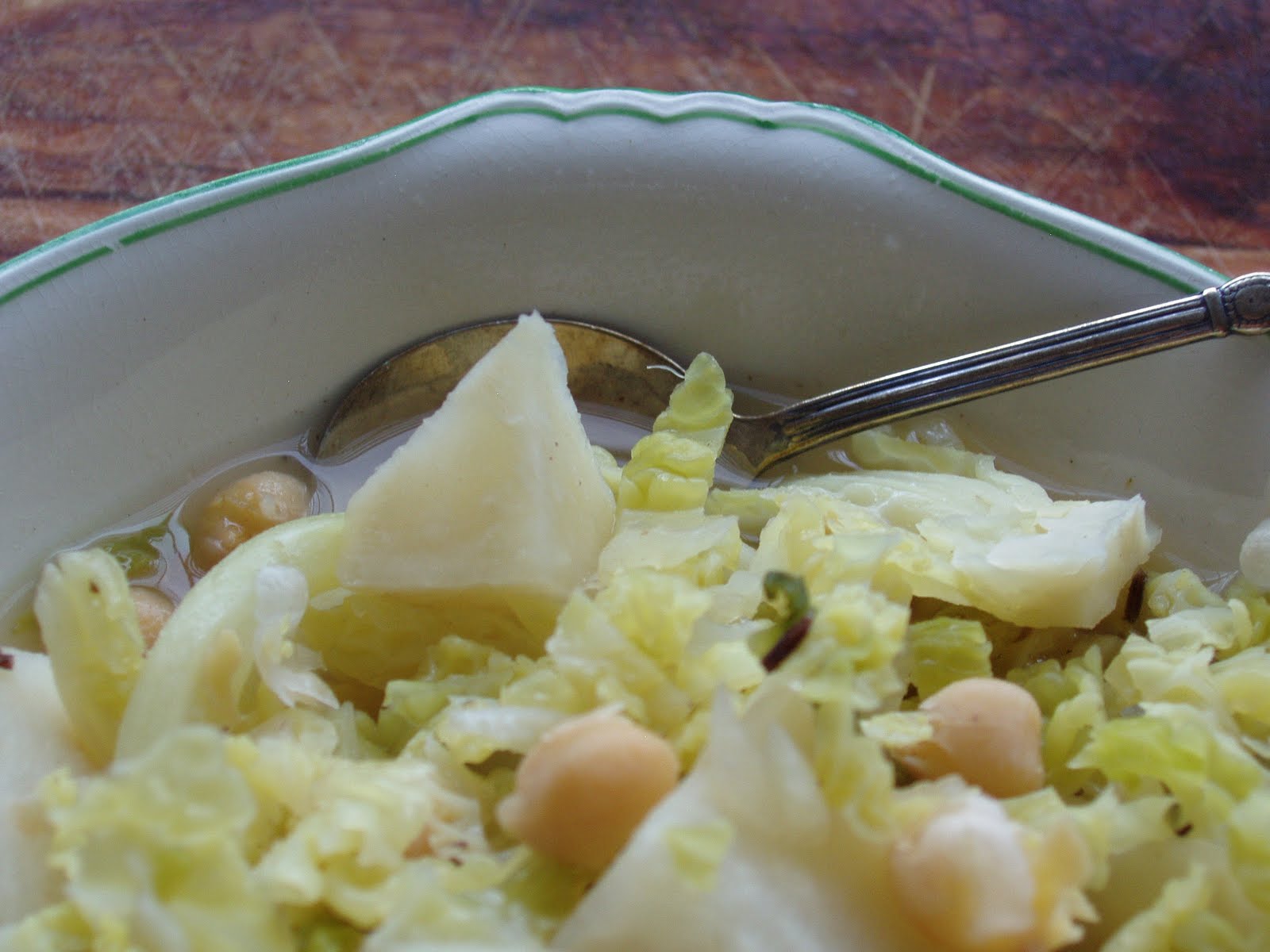
Celeriac, Chickpea and Cabbage Soup


I grew up gleaning food. We had different walks home from school depending whether it was the season for loquats, feijoas or cherry plums, or whether mum needed us to grab a few bay leaves. Even now, thirty years later, I still get an enormous kick out of finding food in public spaces; it's an even bigger kick in a built-up suburb like Brunswick.

This week, I've nipped bay leaves off a hedge a few blocks away; fennel seeds from an empty lot near the railway line; and parsley from garden escapees in the lanes near our house. It may not be enough to knit body and soul together, but it is more than enough to flavour soup.

And while spring may have sprung, today it is cold again, and we are promised more delightfully wintry weather for the weekend. As much as I cherish the wintry weather, even I must admit that it won't last forever; the season for soup is drawing to a close. This cold snap may be soup's last hurrah for a while; and so soup is what I have made.

Yet again, I have used celeriac to flavour the soup. It seems to have snuck its way into everything this year, possibly because it has been cheaper than potatoes at the organic shop. Here, it features with cabbage and chickpeas, its soft clean flavour lending brightness to what otherwise might have a cabbage-y boarding-house tendency. The soup is flavoured with the herbal gleanings and homemade stock; it is very economical, yet absolutely delicious. A nice piece of sourdough on the side, and you have a complete meal.

Celeriac, Chickpea and Cabbage Soup

- 4 tbs olive oil
- 5 anchovies (optional)
- 2 bay leaves
- 2 tsp fennel seeds, crushed
- 1 brown onion, chopped
- 800g celeriac
- 200g dried chickpeas, soaked overnight then cooked until soft
- 400g Savoy cabbage, shredded
- 1 litre hot chicken stock (recipe here)
- salt, pepper
- parsley, chopped
- parmesan (optional)

Warm the olive oil in a large soup pot. Add the anchovies and push them around with a wooden spoon for a minute or two, or until they have turned to paste. Add the bay leaves and fennel seeds, and cook for another minute. Add the onion and celeriac, turn the heat down, and cook until soft.

Add the cooked chickpeas, the cabbage, and the chicken stock, and season. Cover and simmer for half an hour or until the celeriac is cooked through.

Check for seasoning, sprinkle with parsley, and pass the parmesan.

Simplified from a recipe in the fantastic River Cafe Cookbook Green.

(Local: celeriac, chickpeas, cabbage, bay leaves (nipped from an overhanging tree a few blocks away), fennel seeds (scrounged from the railway line), parsley (picked from a garden escapee in a laneway since our chickens got to ours), olive oil. Victorian: onions, salt. Various provenances which I can't be bothered to list: chicken stock ingredients, anchovies (sustainably fished). La bella Italia: parmesan.)


The River Cafe Cookbook Green

Sunday, August 28, 2011

Unleavened Bread


When I was in the States last year, I noticed a line of breads and cereals called Ezekiel 4:9. Ezekiel 4:9 reads 'Take also unto thee wheat, and barley, and beans, and lentils, and millet, and spelt, and put them in one vessel, and make bread of it' – and so, millennia later, they did, sealed it up tight with plastic wrap, and slapped on a trademark.

Well, I thought. Those crazy Americans will make a niche brand out of anything.

Then last week I noticed a similar line at my local organic shop; it appears that we are susceptible to crazy niche brands, too. Yet I can't laugh too hard at food with Biblical references: lately I've been enjoying A Biblical Feast: Foods from the Holy Land by Kitty Morse. I picked it up to use with the kids at church, and to my delight I have found it to be packed with deeply satisfying recipes. Lentil, watercress and goats' cheese salad; millet with saffron and walnuts; toasted almond and sesame seed dip; pomegranate honey-glazed grilled fish; and all sorts of other good things to eat.

Much of it feels like it's come straight from the earth. For some reason, I never get this sense from root vegetables; instead, it's lentils, goats' cheese, olives and herbs which are, for me, the staff of life. Unleavened bread, in particular, feels healing; I make it when I'm feeling fragile or melancholy and it goes a long way towards setting me to rights.

Unleavened bread exists in many cultures and is known by many names. Fundamentally, though, it's bread made without yeast which sits for only a little while before it is cooked. Thus not only does it have no yeast added; it has very little to no opportunity to gather in wild yeasts from the atmosphere.

Such a bread comes out flat and chewy; it feels real in a way that even the best baguette never will. It can be made from pretty much any flour, but I make mine from a combination of spelt and rye. I love spelt, an ancient form of wheat, for its deep slaty flavour. It tastes strongly present, in the here and now, and yet also like something you'd be served in a stone hut; this is food from the ages. Meanwhile, rye lends a hint of molasses and depth of colour.

However, the bread can also be made with plain wheat flour, or whatever else is to hand. The whole point of peasant food is that it is made with what is available. Run out of spelt? Use a combination of ground millet and rye. Rats got into the millet and the rye is causing mass hallucinations? Grind up oats and barley, and you will still have bread; starvation can wait for another day.

And so, while I cannot imagine buying a shrink wrapped bread with a Biblical verse emblazoned on the side, I can see why people are interested in such breads, crazy niche cook that I am. I eat this bread for a light dinner with my largely unsuccessful homemade olives (too soft, too salty, maybe I'll have better luck next year when I'll try the recipes from this book); homemade dips for the adults; bland supermarket dips for the Philistines; a bit of goats' cheese; and maybe a salad of strong herbs.

Unleavened Bread

- 2 cups spelt flour
- 1 cup rye flour
- 1 tsp salt
- 1 tbs nigella seeds
- olive oil

Whisk together the flours with the salt. Make a well, and add about 1 cup of water. Mix in gradually, bringing in flour from the sides of the well, until you have a stringy dough.

Flour the bench and your hands, and place the dough on the bench. Knead for eight to ten minutes – and if you don't know how to knead, this means to fold the dough down from top to bottom with the heel of your hand, make a quarter turn, and repeat – until it feels like a baby's thigh or, if you don't have much contact with babies, like your earlobe. Spelt needs less kneading than regular flour; if you are using regular flour, knead for a few extra minutes. Form it into a ball.

Lightly film a ceramic bowl with oil. Place the dough into the bowl and roll it around so that it is glossy with oil. Drape a tea towel over the top of the bowl, and leave it to rest for anywhere between fifteen and thirty minutes. It will not rise.

Knead it again for a minute or two. Cut the dough into eight pieces (cut in half, then each half in half so that you have quarters, then each quarter in half again so that you get eighths, which is a useful way to teach your kids the square root of four and the cube root of eight, and how denominators work, and what happens when you multiply fractions). Flour the bench again, and a rolling pin. Roll each ball into a pancake about ¼ cm thick; wonky shapes taste better than perfect rounds. Sprinkle with nigella seeds, and roll over the round lightly once again to squish the nigella into the dough.

Warm a drizzle of olive oil in a thick-bottomed skillet over medium heat. When it is pretty warm (but not smoking hot), place a round of bread in the pan. Shake it once or twice to make sure it doesn't stick, and let it cook for two to three minutes. Turn it over; it should be dotted with a round brown circles.

Cook on the second side for another two minutes or so. It will puff up in places; if you want to maximise the puff, take a rolled tea towel and gently press around the edges of the round as it is cooking.

When it is done, loosely wrap it in a clean tea towel while you cook the rest, stacking them as they are done with the first; eat warm.

(This all seems rather a palaver when spelled out in a recipe, but you will quickly develop a rhythm whereby you cook one while you roll out the next or even, like me, have two kids rolling and two skillets on the go, in which case it only takes about fifteen minutes to cook them all. And it's fun.)

Adapted from a recipe in A Biblical Feast by Kitty Morse.

(Local: spelt (Powlett Hill), olive oil. Mysterious provenance: rye, nigella, salt.)


A Biblical Feast: Food from Biblical Times to Today

Tuesday, August 16, 2011

Kale Soup, Winter 2011


I once frequented a hairdresser in a trendy strip. He told me that, despite specialising in dreadlocks and mohawks and very short haircuts for girls, a tiny older woman came in once a month to have a blue rinse. That particular shopfront had been a hair salon for more than forty years, and she saw no reason to go somewhere else just because the owners had changed and the ethos shifted. So my hairdresser kept a supply of blue rinse chemicals on hand for her, and hoped and prayed that nobody else ever found out that he did them.

Being someone who is fairly oblivious to fashion, I found it rather touching. I loved the idea of my hairdresser, a muscular skinhead, carefully tinting a tight white perm to the perfect shade of blue. After all, I am probably going the same way as his customer, insisting that my current hairdresser keep my hair in a certain edgy crop years about a decade after it has lost its edge. Apparently I am now supposed to have it thick and top heavy, but having done that in my early twenties, I'm comfortably past that. In fact, I keep finding myself wanting to compliment young waiters and bartenders on their pinching high-waisted acid wash jeans and rolled brim hats; after all, I wore all that that when I was a teenager. Their clothes makes me happy in a sentimental sort of way.

As much as I am no longer au fait with current fashions, or at least choose to ignore them, I do have trends when it comes to cooking. The silhouette of my trousers may be fairly constant, and my hair has barely changed since 2003, but I have changed my preferences for soup. Last year I enjoyed my version of the ribollita served by our landlady in Tuscany many years ago, a sort of wet compost. But this year my tastes have changed. I no longer want a blended soup thickened with bread; instead, I yearn for kale soup with firm vegetables, separate and distinct. I've also become a purist, wanting only cavolo nero, or Tuscan black kale. When cooked, black kale has a rich sweet flavour that I love.

So this is what I'm eating in the winter of 2011. It draws from Skye Gyngell's recipe in her lovely book, My Favourite Ingredients, but as usual I make my own departures.

Kale Soup, Winter 2011

-200g dried cannellini beans, soaked overnight
- 3 small brown onions, chopped
- 3 cloves garlic, flattened with the side of a knife and roughly chopped
- 2 large potatoes, peeled and chopped
- 1 bulb celeriac
- 4 smallish carrots
- 1 can tomatoes
- a big bunch of cavolo nero (that long skinny black kale)
- 150g stellini (tiny star shaped pasta; I used wholemeal spelt stellini, but use whatever makes you happy)
- salt, pepper
- parmesan (totally optional)

Drain the soaked beans in a colander. Place them into a big saucepan and cover them well with cold water. Bring to the boil, then lower the heat and simmer for 1 to 1½ hours, or until they are soft but not falling apart. Salt, and set aside.

Warm a good slosh of olive oil in a soup pot. Add the onions and a pinch of salt, and cook over medium heat until translucent. Add the garlic and the celeriac, carrots and potatoes. Cook until the vegetables turn glossy, then add the tomatoes. Mix well, turn the heat right down, clap the lid on and leave to cook for twenty minutes.

Remove the thick stems of the kale and chop the leaves coarsely. When the other vegetables are done, add the kale, the cannellini beans and about a litre of water – just enough to cover. Replace the lid, and cook gently for 45 minutes to an hour, or until the vegetables are really soft.

Meanwhile, bring a pot of water to the boil (I used the bean pot to save on washing up). Salt, throw in the stellini and cook until barely done, perhaps a minute less than the instructions say. Drain and toss the stellini with a drizzle of olive oil and set aside.

When the soup veggies are soft and you are ready to eat, throw the stellini into the soup, warm them, and serve. A bit of parmesan grated over the top is nice, as is an extra drizzle of bright green olive oil and some freshly ground pepper.

(Local: kale, potatoes, onions, celeriac, carrots. Victorian: salt. From infuriatingly many miles away: parmesan, pepper, dried white beans, canned tomatoes (I never did get round to canning tomatoes last summer dammit, and could someone please tell me why is it so hard to get organically grown dried white beans and canned tomatoes from Victoria?)


My Favourite Ingredients