Showing posts with label celeriac. Show all posts

Tuesday, September 6, 2011

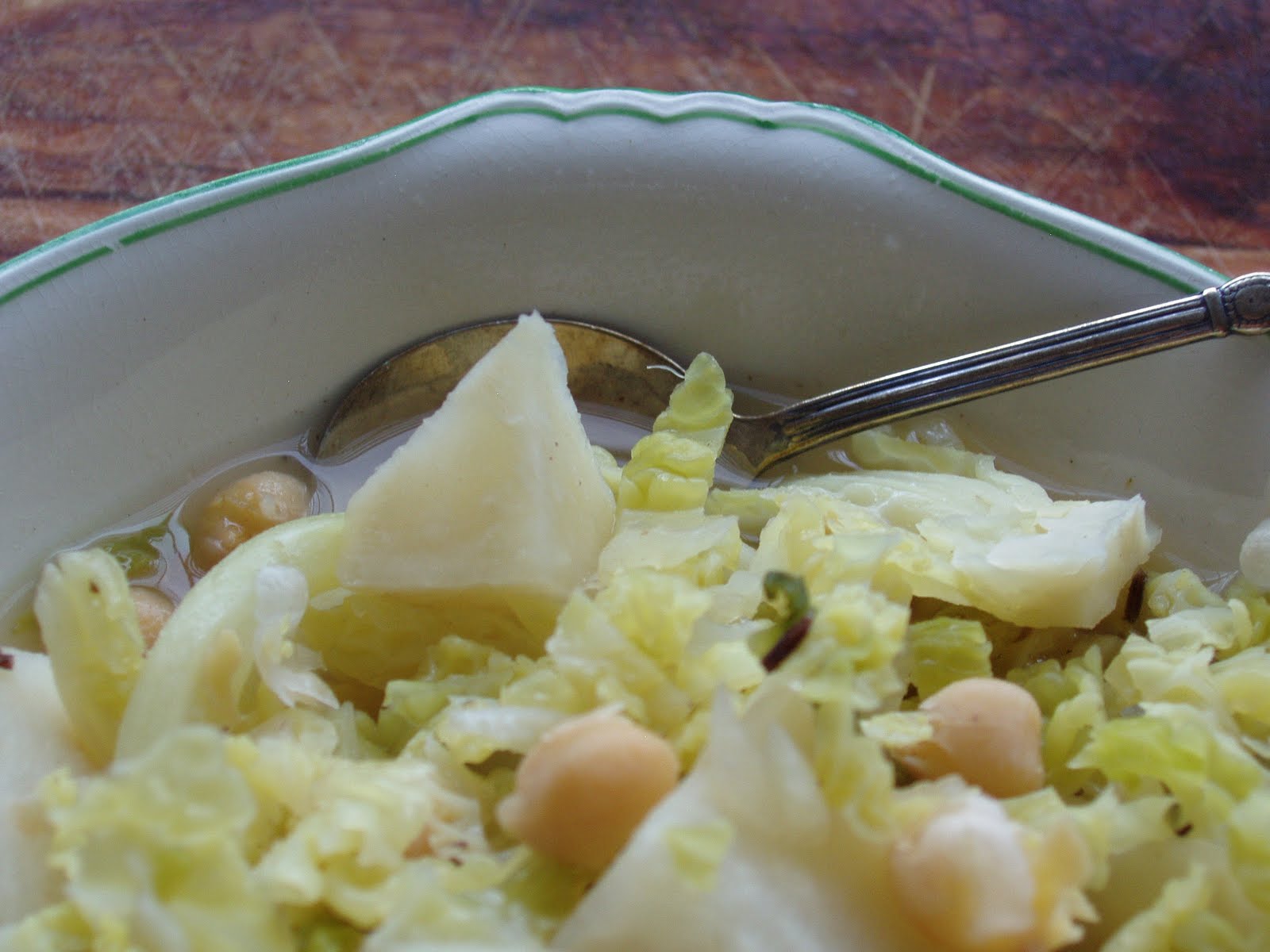
Celeriac, Chickpea and Cabbage Soup


I grew up gleaning food. We had different walks home from school depending whether it was the season for loquats, feijoas or cherry plums, or whether mum needed us to grab a few bay leaves. Even now, thirty years later, I still get an enormous kick out of finding food in public spaces; it's an even bigger kick in a built-up suburb like Brunswick.

This week, I've nipped bay leaves off a hedge a few blocks away; fennel seeds from an empty lot near the railway line; and parsley from garden escapees in the lanes near our house. It may not be enough to knit body and soul together, but it is more than enough to flavour soup.

And while spring may have sprung, today it is cold again, and we are promised more delightfully wintry weather for the weekend. As much as I cherish the wintry weather, even I must admit that it won't last forever; the season for soup is drawing to a close. This cold snap may be soup's last hurrah for a while; and so soup is what I have made.

Yet again, I have used celeriac to flavour the soup. It seems to have snuck its way into everything this year, possibly because it has been cheaper than potatoes at the organic shop. Here, it features with cabbage and chickpeas, its soft clean flavour lending brightness to what otherwise might have a cabbage-y boarding-house tendency. The soup is flavoured with the herbal gleanings and homemade stock; it is very economical, yet absolutely delicious. A nice piece of sourdough on the side, and you have a complete meal.

Celeriac, Chickpea and Cabbage Soup

- 4 tbs olive oil
- 5 anchovies (optional)
- 2 bay leaves
- 2 tsp fennel seeds, crushed
- 1 brown onion, chopped
- 800g celeriac
- 200g dried chickpeas, soaked overnight then cooked until soft
- 400g Savoy cabbage, shredded
- 1 litre hot chicken stock (recipe here)
- salt, pepper
- parsley, chopped
- parmesan (optional)

Warm the olive oil in a large soup pot. Add the anchovies and push them around with a wooden spoon for a minute or two, or until they have turned to paste. Add the bay leaves and fennel seeds, and cook for another minute. Add the onion and celeriac, turn the heat down, and cook until soft.

Add the cooked chickpeas, the cabbage, and the chicken stock, and season. Cover and simmer for half an hour or until the celeriac is cooked through.

Check for seasoning, sprinkle with parsley, and pass the parmesan.

Simplified from a recipe in the fantastic River Cafe Cookbook Green.

(Local: celeriac, chickpeas, cabbage, bay leaves (nipped from an overhanging tree a few blocks away), fennel seeds (scrounged from the railway line), parsley (picked from a garden escapee in a laneway since our chickens got to ours), olive oil. Victorian: onions, salt. Various provenances which I can't be bothered to list: chicken stock ingredients, anchovies (sustainably fished). La bella Italia: parmesan.)


The River Cafe Cookbook Green

Tuesday, August 16, 2011

Kale Soup, Winter 2011


I once frequented a hairdresser in a trendy strip. He told me that, despite specialising in dreadlocks and mohawks and very short haircuts for girls, a tiny older woman came in once a month to have a blue rinse. That particular shopfront had been a hair salon for more than forty years, and she saw no reason to go somewhere else just because the owners had changed and the ethos shifted. So my hairdresser kept a supply of blue rinse chemicals on hand for her, and hoped and prayed that nobody else ever found out that he did them.

Being someone who is fairly oblivious to fashion, I found it rather touching. I loved the idea of my hairdresser, a muscular skinhead, carefully tinting a tight white perm to the perfect shade of blue. After all, I am probably going the same way as his customer, insisting that my current hairdresser keep my hair in a certain edgy crop years about a decade after it has lost its edge. Apparently I am now supposed to have it thick and top heavy, but having done that in my early twenties, I'm comfortably past that. In fact, I keep finding myself wanting to compliment young waiters and bartenders on their pinching high-waisted acid wash jeans and rolled brim hats; after all, I wore all that that when I was a teenager. Their clothes makes me happy in a sentimental sort of way.

As much as I am no longer au fait with current fashions, or at least choose to ignore them, I do have trends when it comes to cooking. The silhouette of my trousers may be fairly constant, and my hair has barely changed since 2003, but I have changed my preferences for soup. Last year I enjoyed my version of the ribollita served by our landlady in Tuscany many years ago, a sort of wet compost. But this year my tastes have changed. I no longer want a blended soup thickened with bread; instead, I yearn for kale soup with firm vegetables, separate and distinct. I've also become a purist, wanting only cavolo nero, or Tuscan black kale. When cooked, black kale has a rich sweet flavour that I love.

So this is what I'm eating in the winter of 2011. It draws from Skye Gyngell's recipe in her lovely book, My Favourite Ingredients, but as usual I make my own departures.

Kale Soup, Winter 2011

-200g dried cannellini beans, soaked overnight
- 3 small brown onions, chopped
- 3 cloves garlic, flattened with the side of a knife and roughly chopped
- 2 large potatoes, peeled and chopped
- 1 bulb celeriac
- 4 smallish carrots
- 1 can tomatoes
- a big bunch of cavolo nero (that long skinny black kale)
- 150g stellini (tiny star shaped pasta; I used wholemeal spelt stellini, but use whatever makes you happy)
- salt, pepper
- parmesan (totally optional)

Drain the soaked beans in a colander. Place them into a big saucepan and cover them well with cold water. Bring to the boil, then lower the heat and simmer for 1 to 1½ hours, or until they are soft but not falling apart. Salt, and set aside.

Warm a good slosh of olive oil in a soup pot. Add the onions and a pinch of salt, and cook over medium heat until translucent. Add the garlic and the celeriac, carrots and potatoes. Cook until the vegetables turn glossy, then add the tomatoes. Mix well, turn the heat right down, clap the lid on and leave to cook for twenty minutes.

Remove the thick stems of the kale and chop the leaves coarsely. When the other vegetables are done, add the kale, the cannellini beans and about a litre of water – just enough to cover. Replace the lid, and cook gently for 45 minutes to an hour, or until the vegetables are really soft.

Meanwhile, bring a pot of water to the boil (I used the bean pot to save on washing up). Salt, throw in the stellini and cook until barely done, perhaps a minute less than the instructions say. Drain and toss the stellini with a drizzle of olive oil and set aside.

When the soup veggies are soft and you are ready to eat, throw the stellini into the soup, warm them, and serve. A bit of parmesan grated over the top is nice, as is an extra drizzle of bright green olive oil and some freshly ground pepper.

(Local: kale, potatoes, onions, celeriac, carrots. Victorian: salt. From infuriatingly many miles away: parmesan, pepper, dried white beans, canned tomatoes (I never did get round to canning tomatoes last summer dammit, and could someone please tell me why is it so hard to get organically grown dried white beans and canned tomatoes from Victoria?)


My Favourite Ingredients

Saturday, May 7, 2011

Chestnut and Celeriac Soup


Ah, chestnuts! Ours come from Gembrook. The trees are tucked into a fold in the hill, below a slope of proteas. To the left, persimmons flame orange in the autumn light; near the house at the top of the hill, an old apple tree rustles with kids. We find a sunny spot to picnic, or flop in lime dappled shade to chat with old friends; then don our toughest boots and gloves and free the fallen chestnuts from their spiky casing.

The chestnut harvest is an annual event; but this year we couldn't make it. Instead a friend collected us a basketful of nuts for which I am thankful; and after a year of good rain, this was a bumper crop indeed, the nuts gloriously fat and swollen.

Not only are there now chestnuts in the fridge, but, at the organic shops at least, celeriac is cheaper than potatoes. Brisk mornings, cold nights, leaves changing colour: everything calls out 'Soup! Soup! Beautiful soup!' and I do too.

River Cafe Cook Book Green has an excellent recipe for chestnut and celeriac soup; but as is my wont, I have stripped back a few ingredients and made it a little more rough and ready. My version is perhaps not as precisely and delicately flavoured, but it is cheerfully delicious enough for me. Once the chestnuts are prepared, I can whip it together in a few minutes while kids are snoozing, then catch forty winks myself while the house slowly fills with the comforting smell of soup.

Two notes on chestnuts:

(1) Although they are usually sold unrefrigerated, they do go rancid and mouldy very quickly. As soon as you get them home, store them in the fridge until you need them.

(2) Most cooks recommend cutting a cross in the shell of the nut and boiling, which I have indeed done for many years. However, I have just tried the method described below and it is far more effective and forgiving on the fingers. Done this way, many nuts just pop out of their shell and skin; those that don't are quickly peeled. Even better, popping or peeling from a single cut rather than a cross means no pointy triangles to accidentally shove under your fingernails; thus no shooting pain; thus infinitely superior, indeed! A debt of gratitude to Jerry Traunfeld and his lovely book, The Herbal Kitchen.

Chestnut and Celeriac Soup

- 600g fresh chestnuts in their shells, to make about 400g chestnut meats
- walnut sized lump of butter
- 1 brown onion, chopped
- 2 celeriac, knobbly skin carved off and diced
- 1 celery heart (this is the small inner cluster of a head of celery, rather more yellow than green), sliced finely from the base to the leaves
- 2 bay leaves
- ¼ cup dry sherry
- olive oil and/or double cream
- Parmesan
- a hefty pinch of salt

First, prepare the chestnuts. (I usually do this a night or two ahead, after dinner, and store the chestnut meats in the refrigerator until I am ready to cook them.) Hold a chestnut flat side down on a sturdy chopping board. Place the tip of a sharp knife at the top of the nut, and lever it downwards so that the nut is bisected from top to bottom, but the knife does not cut through the shell on the flat side. (This is far more straightforward than it sounds.) Place the chestnut into a bowl. When all the chestnuts have been treated thus, place the bowl of chestnuts into the freezer for ten minutes.

Bring a large pot of water to the boil. When the ten minutes is up, remove the chestnuts from the freezer and slide them into the rapidly boiling water. Boil for eight minutes. Turn off the heat. Remove several chestnuts from the water with a slotted spoon, and quickly pop each nut half out of its shell and skin (or peel it). Continue until you have liberated all the nuts. Work fast, because as the nut cools the skin reattaches itself very firmly.

If one or two chestnuts will not easily relinquish the inner skin, just sacrifice a little chestnut and slice it off rather than send yourself batty trying to peel it. Now the chestnuts are ready, and here you can pause for a day or two to suck your scalded fingers and recover, or, bless your soul, continue.

Warm a good knob of butter in a soup pot. Add the onion and a pinch of salt, and sauté over medium heat for several minutes until the onion begins to soften. Add the celeriac and the celery, and stir well. Add the chestnuts and the bay leaf, stir again, and add the sherry. Let it reduce substantially, then barely cover the lot with boiling water. (If you have homemade chicken stock on hand, you can use it here instead of water. Just don't use the fake stuff because then the soup will taste of every other soup which is made with pseudo-stock, viz. metallic and salty; and in any case, it will make your tongue feel thick.) Season.

Allow the soup to simmer until the celeriac is soft, about thirty minutes. Mash roughly with a potato masher, or pulse-chop half the soup in a food processor and return to the pot. This way you get some texture, and some soupy suspension. Taste for salt, undersalting rather than otherwise as the parmesan adds extra salt.

To serve, ladle out a bowlful. Drizzle with some peppery olive oil and/or a spoonful of double cream, and sprinkle with freshly grated parmesan.

(Local: chestnuts, onions, celeriac, bay leaves, olive oil, cream. Not local: butter, celery, sherry, parmesan, salt, pepper.)

Friday, April 29, 2011

Lentil and Celeriac Soup


My birthday: a day of groceries and laundry and nothing particularly special, so I decided to take my youngest out for lunch. Minutes before we left the house, however, her eyes went wide. 'Nappy!' she yelled urgently, 'Now'!'; then proceeded to fill it in spectacular fashion. As I cleaned her up, I asked how she was feeling. 'Not so good,' she said, 'my tummy funny'. Should we go out, I asked. 'Maybe not,' she said, then, one finger raised to the ceiling and a broad smile on her face she said, 'I have an idea: we could have birthday lunch at home!'.

Such a stroke of brilliance from a two year old is rather touching, all things considered; and we stayed in. I read a few more stories and built a marble run, then we sat down to lunch at, as always, the back table. Happily, I had made lentil soup earlier in the week, and we had some good cheese. As I sniffed my soup, I reflected that being home for lunch, while mundane, could still be very pleasant indeed.

When I had made the soup, I was looking for the autumnal feel of lentils without heaviness. Rather than a spicy thick red slurry, I had imagined pretty slate-green lentils, which hold their shape so well, piled into a light broth. I added carrots for their sweetness, and celeriac for its light clean flavour; and after the vegetables had sautéed for a while I threw in a generous slosh of martini bianco and let it reduce.

Martini bianco is a sweet Italian vermouth, herbaceous with a hint of vanilla. Vermouth is a mixer, but as I have no head for strong martinis I mix it into soup, stew and risotto instead! Here, the sweetly herbal flavour cut through any tendency to heaviness. The soup ended up gentle, fragrant, and soothing; everything I could have wanted in a week of nippy mornings, sunny days and exciting nappy events!

Lentil and Celeriac Soup

- 1 brown onion
- 2 carrots
- 1 celeriac
- ¾ cup green Puy style lentils
- a bay leaf
- a decent slosh vermouth, preferably Martini bianco
- 4 cups or so water
- olive oil
- five or six stems of flat leaf parsley, chopped finely
- a hefty pinch of salt

Chop the onions finely. Warm the olive oil in a soup pot, and add the onions and a pinch of salt. Cook over medium heat while you chop the celeriac and carrots into small dice. When the onions are translucent, add the celeriac, carrots and bay leaf, and push them around with a wooden spoon until they are glossy. Add a slosh of vermouth (2 to 3 tablespoons), and let it reduce, which it will do almost immediately.

Add the lentils and the water, and bring to the boil. Reduce the heat to a gentle simmer, and let cook for half an hour. Taste for salt, remembering that lentils do need a good bit of salt, and cook for another ten to fifteen minutes, or until the lentils are just cooked. Puy lentils hold their shape; you are not looking for sludge.

Serve with a good sprinkling of freshly chopped parsley, and a swirl of olive oil.

This soup is delicious immediately. You can store it for a few days in the fridge, as did I, but the lentils absorb all the moisture and you will need to add more water each time you re-heat it, thus diluting the already light flavour; it was best on the first day.

(Local: onions, celeriac, carrots, lentils, bay leaf, parsley, olive oil. Not local: vermouth, salt, pepper.)

Saturday, March 26, 2011

Celeriac Rémoulade


Are more types of vegetables commonly available than when I was a child? I often read about the drastic decline in agricultural variety; and yet I can think of so many veggies – asparagus, kohlrabi, celeriac, sweet potato, fennel, Brussels sprouts, purple turnips, white turnips, beetroot, chard, snow peas, shallots, chicory, broad beans, red pepper – that I never ate or even saw as a child and which we now eat all the time.

I wonder, in fact, whether we have lived through the Great Decline – embodied in my family history by my grandmother's cooking: perfectly adequate, but regarded by her as a mimic of the Real Thing, that is, store-bought food, and accordingly bland – and are now experiencing a Great Resurgence? Or is this merely because I am wealthy, pretentious, and shop organic? I wonder.

One of my favourite vegetables, discovered only a few years ago, is celeriac. I had read about this vegetable, intrigued. I perused my recipe books, and contemplated how a tuber might taste earthy and yet still like bright green celery; I pored over descriptions of the knobbly root; I wondered whether I would ever taste it... then lo! celeriac appeared at our local shops and yea, I bought it and hallelujah! it was good. Selah.

Celeriac is delicious in a lentil stew; but it is most excellent in its classic preparation, celeriac rémoulade. The vegetable is shredded and tossed through a mustardy mayonnaise with parsley or tarragon. Celeriac rémoulade is lovely at dinner as a side dish; but at lunch, it takes centre stage. With some bread, some olives and some sliced ham, such a lunch can be magnificent.

The recipe that follows includes the recipe for mayonnaise posted earlier.

Celeriac Rémoulade

- 1 celeriac
- a lemon

For the mayonnaise
- 2 egg yolks, at room temperature
- 1 tbs lemon juice plus more to taste
- 1 tbs seeded mustard
- 1 to 2 tbs chopped parsley or tarragon
- about 200ml olive oil
- salt to taste

Place a heavy bowl on a damp cloth on the bench; the cloth will stop the bowl from sliding around. Place the egg yolks, lemon juice, mustard and a pinch of salt into the bowl, and whisk. The bigger the balloon of the whisk, the easier this is.

Add the olive oil just a drop, and I do mean just a drop, at a time, whisking frantically all the while. This job is made infinitely easier if you have an oil nozzle on your oil bottle. Once you have added a couple of tablespoons of oil drop by drop, and the mixture is starting to look like mayonnaise, you can add it in a thin stream, still whisking continuously (I use my left hand to drizzle, and my right to whisk; you could also use an apprentice to drizzle as long as the apprentice understands that they must not slosh it in). When most of the oil has been added and you have a lovely soft glop, taste for lemon and salt, and correct as needed. Leave it very slightly bland as the lemon juice on the shredded celeriac will sharpen the flavour.

(If the oil is added too quickly, the mayonnaise can split. If it does, place another egg yolk into a clean bowl and whisk it. Gradually add the mayonnaise a little at a time, whisking frantically all the while, until it is combined and all is right with the world. Alternatively, you can whizz it in the food processor, although it won't be as lovely and light.)

Using a heavy sharp knife, carve off the wrinkly skin of the celeriac. You may need to slice quite deeply to remove all the grubby bits. Grate the root on the large holes of a box grater, and place the gratings into a bowl. Toss them with the juice of half a lemon, then drop them into the bowl of mayonnaise and mix well.

Serve at once, or store in the fridge for up to a day until needed. I make celeriac rémoulade for dinner, and eat leftovers for lunch the next day with bread, ham and glee.

(Local: eggs, celeriac, lemon, olive oil, herbs. Not local: mustard, salt.)