Showing posts with label chickpeas. Show all posts

Thursday, November 3, 2011

Farinata

 
Farinata

How delightful it is to discover a new comfort food! I had always thought comfort foods were those carbohydrates first eaten during early childhood, with their deeply familiar flavours and their taste of home, like good bread with salted butter; or really fresh stretchy pita; or burning hot chips, crisp and salty on the outside, soft and mealy within. These are pleasure enough – but one of the joys of being an adult is that I keep finding new foods to add to the list!

I’ve always liked Lebanese pastries, but when I first bit into the spelt version of the haloumi pie at Mankoushe on Lygon Street, I knew I had discovered the perfect dish. Hot, salty, cheesy, with the deep slaty taste of spelt, heat blistered, and brushed with olive oil: this is comfort food at its best – and is, perhaps, why the Mankoushe boys, dishes themselves, wave whenever we go by: we are their best customers.

Even more recently, I discovered farinata. Farinata is a thick chickpea flour pancake flecked with salt and rosemary. It is that perfect combination of hot and crisp at the edges and mealy inside; and it is savoury, filling, and flavourful. Even better, it is so quick and simple to make that it is a wonder it is not more widely known; the only step that takes any time at all is leaving it to soak for a couple of hours.

I’m so enamoured with farinata that I’ve been making it twice a week for dinner, with a couple of hefty salads on the side. It’s best served hot straight from the pan; but even eaten the next day, whether cold or warmed in the microwave, it is still good.

Farinata doesn’t have to be eaten at dinner. According to Skye Gyngell in her lovely book My Favourite Ingredients, farinata is the traditional breakfast food for Genoese fisherman. I, however, struggle to eat breakfast any later than the time it takes me to shuffle down the hall to the kitchen, so I am yet to find out whether it’s good just then. However, like all salty foods farinata cries out for beer, and I’m looking forward to warmer weather and drinkies in our complete mess of a garden with a slice of farinata in one hand, and a cold beer in the other.

The ingredients are not quite local (I am not sure which bit of Australia provides the chickpea flour in the organic shop), but it is so good that I can’t help but include it in this blog. If you need an excuse to cook a non-local food, farinata is gluten free, sugar free, vegan, and economical. And because pricing completely fails to take into account the distance food has travelled, if you use an imported chickpea flour (also known as besan flour, and readily available in Indian and Pakistani shops), it will be even cheaper.

In Liguria, farinata is made in a large zinc lined copper pan. As I am not Ligurian and don’t have a great pile of specialist cooking equipment, I have adapted the recipe for my thick bottomed stainless steel frying pan 30cm (12”) in diameter. Whatever pan you use, make sure it can go into the oven.

Farinata

- 150g chickpea flour (also sold as besan flour)
- 500ml lukewarm water
- a very hefty pinch of sea salt
- ¼ cup plus a tablespoon of extra virgin olive oil
- a long stem of rosemary

Place the chickpea flour and a pinch of salt into a large bowl. If the flour is very lumpy, sieve it; otherwise press out any lumps with a whisk. Make a well in the centre. Gradually add the water, whisking constantly as you slowly incorporate the flour; you should end up with a runny yellow batter.

Leave it to sit for 2 to 4 hours. (I have eaten farinata under the guise of chickpea fritters at several bars and been left with an unpleasant grainy texture on the back of my teeth, like a scone that lacks the necessary pinch of sugar. Leaving it to sit and very slightly ferment seems to fix this problem.)

Pick the leaves from the rosemary.

Place an oven rack in the top half of the oven (not the topmost row, but the one below it), and preheat the oven to 225°C (450°F).

Stir ¼ cup olive oil into the batter.

Place the frying pan on the stovetop, and heat the tablespoon of oil until it is just beginning to smoke. Pour in the batter – it will frill up at the sides like a frittata – and scatter it with rosemary. Gently slide the pan into the oven.

Bake for 15 to 17 minutes, until the edges are crisp, the top is golden, and the middle is perfectly mealy. Sprinkle with extra salt flakes, and serve immediately. This makes enough for a bunch of people to have a taste, four or five people to eat with other things, or for two hungry greedy people to demolish with gusto. Gyngell recommends eating farinata topped with flecks of sweet gorgonzola... sounds good, but I haven’t tried it! She also has a recipe for farinata, but I prefer the thinner batter used above.

From a recipe in the The River Cafe Cook Book Green, adapted to home cooking conditions and equipment.

(Backyard: rosemary. Local: olive oil. Somewhere in Australia: chickpea flour. Not so local: salt.)

The River Cafe Green Cook book My Favourite Ingredients

Monday, October 24, 2011

Das's Chickpea Salad

 
I never meant to threaten my housemate with a knife.

I was living at the time with a couple of Anglo women who studied too hard, and a Pakistani man named Das. Das had very regular habits. Every morning, he left for work in his little white car; every evening, he came home, parked in the driveway, stayed for an hour or two then, while we women headed back to our desks, he went to put in a few hours at a friend’s restaurant. On weekends, if we were lucky, he cooked.

One weekday I came home to what should have been an empty house. The driveway was empty, but to my alarm the front door was swinging open. I peeked in, and called ‘hello?’. There was no answer, so I called louder. Again, silence. Heart pounding, I stepped softly into the hallway, tiptoed to the kitchen and, being a silly young thing, grabbed a long knife. Then I crept around the house, checking each and every room – behind the doors, under the beds, the works – until I came, at last, to Das’s room. He wasn’t home; his car wasn’t in the driveway; he was at work.

But I thought I heard the sound of breathing.

So I crept in, knife raised high, only to find Das dozing on the bed. I shrieked, he opened his eyes and yelled, and I collapsed in hysterical giggles.

It turned out he’d felt sick at work. He’d left in a daze early, parked his car randomly up the street, staggered in the front door, and collapsed into bed, only to be woken by the knife wielding maniac that was me.

These days I’m older and wiser; I figure I’m the only person likely to be injured in a knife fight. So I keep my kitchen knives where they belong, and use them to chop vegetables and think of Das.

He was a terrific cook. I particularly remember eating industrial quantities of his chickpea salad, served warm. I still dream of it; mine, sadly, is never as good.

Chickpea salad is very simple, but it depends on two things. For one, I have never eaten a canned chickpea that hasn’t tasted tinny, so I cook my own from dried. If you don’t mind the tinny taste, you are welcome to use canned chickpeas, but for mealy chickpea perfection, cook them yourself.

The other is to chop the other vegetables neatly, chickpea sized or smaller. It makes the salad visually appealing, and it means that each mouthful is an explosion of different flavours.

Chaat masala is a spice mix for salads. Dried green mango and asafoetida give it sourness; and then about a dozen other spices just make it taste good! You can buy it at any Indian or Pakistani grocery store. It’s worth having a packet in your pantry just for this salad; I certainly do.

Das’s Chickpea Salad (Very Easily Multiplied!)

- 1 cup cooked chickpeas. If they are warm, so much the better.
- 2 medium carrots, diced small
- 1 celery heart, or 2 stalks celery
- 1 long cucumber
- a small bunch of coriander, chopped
- a hefty pinch of chaat masala
- the juice of a lemon

If you are using the celery heart, shred it crossways right up into the yellow leaves. If you are using celery stalks, dice them as small as the carrot.

Peel the cucumber entirely if the skin is coarse. Halve it lengthways. Cut out the seeds by slicing a shallow V and scraping them out. Dice the remaining flesh nice and small.

Chop the coriander coarsely.

Combine the chickpeas with the vegetables and the coriander. Dress with a generous amount of lemon juice, and sprinkle with a little chaat masala to taste. Mix well.

This makes enough for two or three lunches. In lieu of my mother’s chappatis – how I miss them! – I eat it with homemade unleavened bread made with buckwheat flour and sprinkled with nigella, or with fresh pita.

(Localish: chickpeas from Horsham area; carrots, coriander, lemons. Not so local: celery, salt, chaat masala.)

Tuesday, September 6, 2011

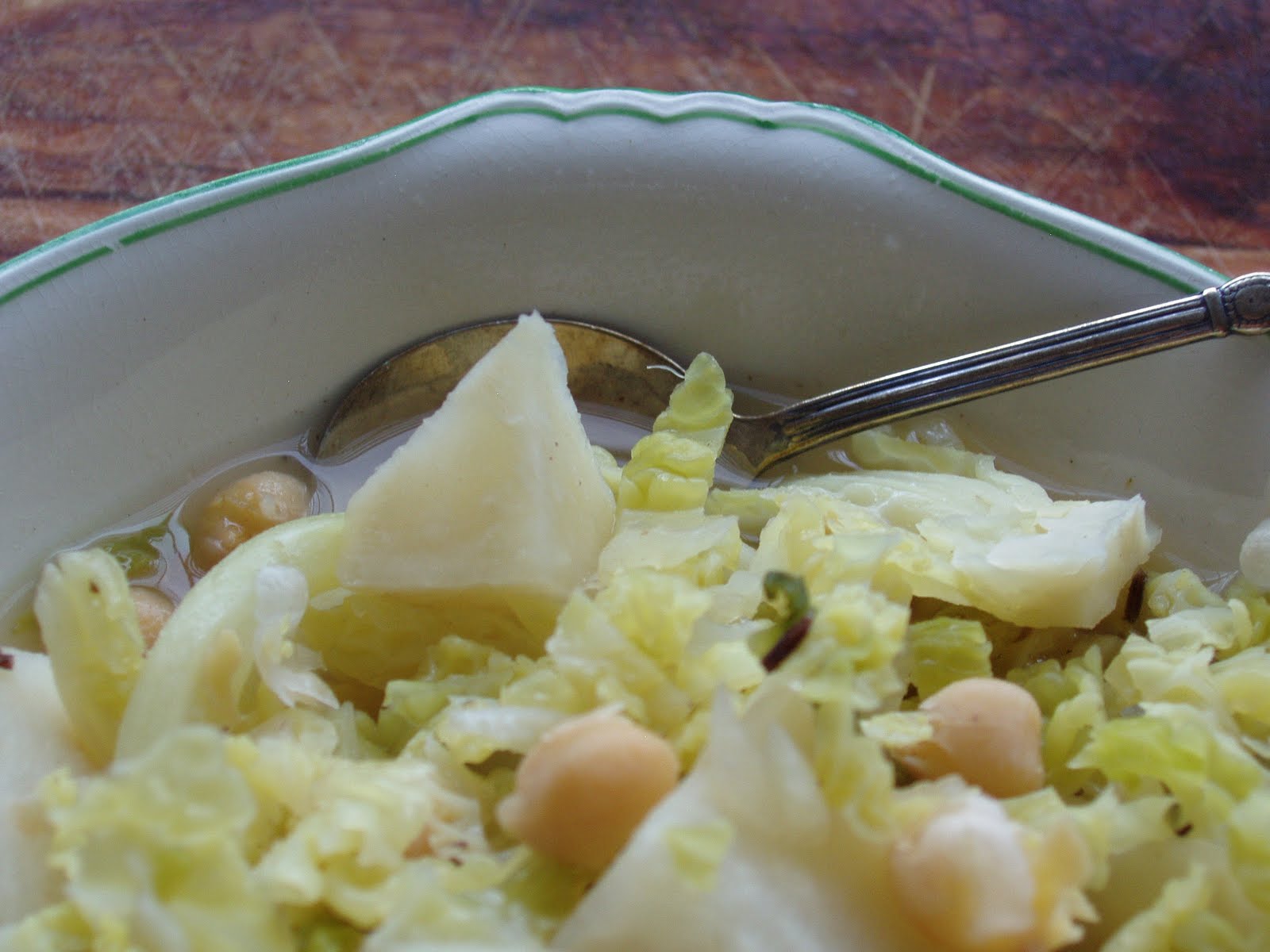
Celeriac, Chickpea and Cabbage Soup


I grew up gleaning food. We had different walks home from school depending whether it was the season for loquats, feijoas or cherry plums, or whether mum needed us to grab a few bay leaves. Even now, thirty years later, I still get an enormous kick out of finding food in public spaces; it's an even bigger kick in a built-up suburb like Brunswick.

This week, I've nipped bay leaves off a hedge a few blocks away; fennel seeds from an empty lot near the railway line; and parsley from garden escapees in the lanes near our house. It may not be enough to knit body and soul together, but it is more than enough to flavour soup.

And while spring may have sprung, today it is cold again, and we are promised more delightfully wintry weather for the weekend. As much as I cherish the wintry weather, even I must admit that it won't last forever; the season for soup is drawing to a close. This cold snap may be soup's last hurrah for a while; and so soup is what I have made.

Yet again, I have used celeriac to flavour the soup. It seems to have snuck its way into everything this year, possibly because it has been cheaper than potatoes at the organic shop. Here, it features with cabbage and chickpeas, its soft clean flavour lending brightness to what otherwise might have a cabbage-y boarding-house tendency. The soup is flavoured with the herbal gleanings and homemade stock; it is very economical, yet absolutely delicious. A nice piece of sourdough on the side, and you have a complete meal.

Celeriac, Chickpea and Cabbage Soup

- 4 tbs olive oil
- 5 anchovies (optional)
- 2 bay leaves
- 2 tsp fennel seeds, crushed
- 1 brown onion, chopped
- 800g celeriac
- 200g dried chickpeas, soaked overnight then cooked until soft
- 400g Savoy cabbage, shredded
- 1 litre hot chicken stock (recipe here)
- salt, pepper
- parsley, chopped
- parmesan (optional)

Warm the olive oil in a large soup pot. Add the anchovies and push them around with a wooden spoon for a minute or two, or until they have turned to paste. Add the bay leaves and fennel seeds, and cook for another minute. Add the onion and celeriac, turn the heat down, and cook until soft.

Add the cooked chickpeas, the cabbage, and the chicken stock, and season. Cover and simmer for half an hour or until the celeriac is cooked through.

Check for seasoning, sprinkle with parsley, and pass the parmesan.

Simplified from a recipe in the fantastic River Cafe Cookbook Green.

(Local: celeriac, chickpeas, cabbage, bay leaves (nipped from an overhanging tree a few blocks away), fennel seeds (scrounged from the railway line), parsley (picked from a garden escapee in a laneway since our chickens got to ours), olive oil. Victorian: onions, salt. Various provenances which I can't be bothered to list: chicken stock ingredients, anchovies (sustainably fished). La bella Italia: parmesan.)


The River Cafe Cookbook Green

Wednesday, March 2, 2011

Couscous and Chickpea Salad


When I was a kid, I hated school lunches. I vividly remember the exotic food my friend Marion used to bring to high school: leftover pasta, jaffles filled with beans, doorstop sandwiches made with sourdough, and other interesting food. I'd sit beside her on the cold concrete step chewing on a flabby pressed chicken sandwich and look on enviously while she opened little tubs with interesting smells and attacked them with spoon or fork.

Now I have schoolkids of my own, I want them to have the Marion lunch experience – but bizarrely, they are reluctant. Despite my efforts, the philistines insist on nothing more than a Vegemite sandwich or perhaps ham with, as my seven year old says, 'just the barest scraping of mustard'. Good grief.

This salad is one of the delicious things that I can't quite believe my daughters disdain. One eats only the chickpeas, picking them out individually; while another eats only the couscous, leaving the chickpeas for the first – at least, like the Sprats, between the two of them they lick the platter clean. As for my four year old, she won't eat it at all without tears; 'I hate the texture,' she says.

A good judge of texture she is not. Perfect grains of couscous cling to grilled vegetables; the chickpeas are deliciously mealy; spinach adds a gentle crunch. Normal children would like it – adults certainly do. It's one of those perfectly satisfying meals in a bowl. We eat it warm for dinner, and cold the next day for lunch, either by itself or tucked into a pita wrap. Yesterday I staggered in from the gym, a little woozy; collapsed into a chair with a container of leftover salad; demolished it in minutes; and felt instantly restored in body and soul. So I at least got a good lunch out of it, even if nobody else did.

The recipe builds on a suggestion by Jamie Oliver to soak couscous in cold water and use it as the base of a vegetable salad. This week, I added a couple of zucchini; other weeks, depending on what's in season, I might add or substitute grilled eggplant, grilled red peppers or even grilled asparagus. The herbs, too, can be played around with; for much of the year I make it with mint and parsley so that it resembles a tabbouli made with couscous not burghul; but when we have an abundance of basil I make it with that, instead. Use whatever's fresh and tastes good to you.

Couscous and Chickpea Salad

- 1 cup dried chickpeas (canned chickpeas taste like glue, but use them if you must)
- 250g couscous
- 280ml water
- juice of 1 or 2 lemons
- 2 tbs olive oil
- 2 or 3 moderately sized zucchini (I had one yellow, one green, very pretty)
- 1 generous handful mint
- 1 generous handful basil
- 2 or 3 handfuls baby spinach leaves

Boil the kettle. Place the chickpeas into a large bowl, and cover them with a generous quantity of boiling water. Leave to soak for several hours.

Drain and rinse the chickpeas, and place them into a large pot. Cover them generously with cold water this time, and bring to the boil. Turn down to a simmer, and let cook for 45 minutes or until they are soft but haven't lost their shape. Throw in 1 to 2 tsp salt, and leave to simmer for another 15 or so minutes. Turn off the heat. Drain just before adding to the salad.

Place the couscous into a large serving bowl. Cover with 280ml water, and leave for 15 to 20 minutes.

While the couscous is soaking, slice the zucchini crossways into thin discs. Grill or sauté the discs with a bit of olive oil until they are soft. Finely chop the herbs.

Using a fork, separate the couscous into individual grains. Add the juice of 1 to 2 lemons (I like it sharp), and drizzle in the olive oil. Mix well. Add the herbs, the zucchini, the spinach and the chickpeas, and stir to combine.

Serve immediately while the chickpeas are still warm; it's also tasty cold.

Adapted from a recipe in The Naked Chef by Jamie Oliver.

(Local: zucchini, mint, basil, olive oil, lemon juice. Not local: chickpeas, couscous, salt. No idea, but I live in hope that it's local: spinach.)

Wednesday, June 30, 2010

Chickpeas and Silver Beet

 
Ah winter, season of pulses and strong greens. We make some combination – chickpeas and silver beet, borlotti beans and chicory, lentils and spinach – at least once a week.

The following is a flexible recipe. You can vary the proportions of chickpeas to greens; vary the greens used (silver beet, rainbow chard, beet leaves, spinach and chicory all work well); and adjust the aromatics (onions, leeks, and herbs). You can make it wetter and call it soup; toss it through pasta and call it sauce; or pile it high on grilled bread and call it bruschetta. Or do as we do: serve it on bruschetta – made from a good sourdough brushed with olive oil and grilled – and eat the leftovers as soup for lunch the next day. Feeling like a bit of cheese? Sprinkle it with parmesan. Totally ravenous? Slip a poached egg on top.

However you serve it, this is a complete meal: warm and satisfying. The carrots and red onions make it oh so sweet; and the lemon juice brightens and lightens the flavours. It's so delicious that adults find it hard to stop picking – and, ever so thrillingly, my three young children all like it.

Chickpeas and Silver Beet

- 250g dried chickpeas, soaked for a night or two
- 2 cloves garlic, peeled
- 2 small red onions, finely chopped
- 1 or 2 leeks, halved, cleaned well and white parts sliced into narrow ribbons
- 2 carrots, peeled and diced small
- 250ml white wine (I use a cheap but not unpleasant Riesling)
- 2 tbs tomato paste
- 500g silver beet or other sturdy green, washed, stems removed, and chopped
- 10 to 15 stalks Continental parsley, leaves separated from stems, chopped
- 1 lemon, juiced
- olive oil

Place the chickpeas into a large pot with the garlic cloves and a drizzle of olive oil. Cover with cold water, bring to the boil, then simmer gently until soft: 45 minutes to 1½ hours, depending on the age of the chickpeas and how long they were soaked. Skim if necessary. Salt, and leave in their liquid until needed.

Warm a good swirl of olive oil in a wide skillet. Add the onion, leek and carrot and cook gently for 20 minutes, or until the carrots are tender but not brown. Add the white wine and tomato paste, stir to combine, then simmer until almost completely reduced.

Add the silver beet, then clap on the lid and steam until the silver beet wilts, 5 to 10 minutes. Give it a stir every now and then. Add the parsley and the chickpeas, along with half a cup of the chickpea cooking liquid, and cook gently for another 10 to 15 minutes to combine the flavours.

Add the lemon juice, and serve with a drizzle of extra virgin olive oil to finish.

Tumble over bruschetta, toss through pasta, or make it wetter with more chickpea liquor and serve it in a bowl.

This is my own combination, developed from recipes in The River Cafe Cookbook by Rose Gray and Ruth Rogers, and The Savory Way by Deborah Madison. Photograph shows a version with beet leaves and curly kale.

(Local: silver beet, carrots, red onions, leeks, garlic, white wine, parsley, lemons, olive oil. Victoria: chickpeas. Origin unknown: tomato paste.)

Thursday, June 17, 2010

Warm Cauliflower Salad

I've never understood why cauliflower and cheese, macaroni and cheese, rice pudding or baked custard are so often referred to as nursery food. My children loathe and detest anything with a creamy sauce; they'd prefer to relinquish the chance of dessert than to have even an exploratory nibble. From time to time I long for a cheesy bubbly dish with a crusty golden layer on top; alas, it is not to be – at least for now.

So this week, with a cauliflower in the box, I had to think of something else. I flipped through my recipe books, and came up with this. Miss Six gave it an 7 out of 10, which meant she ate a large piece without comment; Miss Four, who is passionate about dukkah, gave it a 3 out of 10, which meant she licked the dukkah off and accidentally ate some cauliflower; but, just like Goldilocks with Little Bear's porridge, I ate mine all up and looked for more.

Dukkah is a mixture of ground seeds, nuts and spices. There are many different mixes available. Our favourite is Paddymelon's Wartaka Dukkah, which includes lemon myrtle, aniseed myrtle and other Australian herbs. It has a lovely fresh flavour; however, any dukkah, perhaps one fragrant with cumin, would also work well. You can find out more about dukkah and order it here.

Warm Cauliflower Salad

- 1 head cauliflower, broken into large florets
- ½ bunch coriander, washed and the leaves taken off the stems
- 1 can chickpeas, or some Victorian chickpeas soaked and cooked, optional (why aren't Australian pulses canned?!)
- 1 juicy lemon
- a good extra virgin olive oil
- dukkah

Bring a large pot of water to the boil. Drop the cauliflower florets in and simmer with the lid off for 7 or 8 minutes, or until a knife blade slips into the stem easily but before the florets are mush.

While it is cooking, warm the chickpeas.

Drain the cauliflower and place onto a platter. Spoon the chickpeas around the florets, then drizzle with olive oil and lots of lemon juice. Sprinkle 2 or 3 teaspoons of dukkah over the top – enough so every floret is lightly dusted. Scatter the coriander leaves over the top, and serve at once.

Developed from a suggestion by Nigel Slater in The Kitchen Diaries: A Year in the Kitchen.

(Local: cauliflower, coriander, lemon, olive oil. Made locally from imported ingredients: dukkah. Imported: chick peas, although you could use Victorian chickpeas.)