Showing posts with label cabbage. Show all posts

Thursday, December 12, 2013

Raw Living Sauerkraut with Caraway and Dill


Fermented foods scare me. I'm totally happy to eat them when prepared by other people, but I'm terrified of making them myself. What if I get it wrong? What if they go off? What if we all get botulism and end up in hospital and, you know, die?

Sure they're traditional, and 'everyone' used to make them – but my mother didn't, and nor did either of my grandmothers. In fact, I don't know anyone who has ever fermented foods, outside the usual group house refrigerator disasters. So I have no knack, no sense of how to do it, and no confidence.

But I eat mountains of living foods, particularly sauerkraut, and they're not cheap: my favourite sauerkraut costs $13.95 a jar. Worse, it comes from Byron Bay in a refrigerated truck – hardly local, sustainable eating for this Melburnian.

So the combination of my cheapness and my desire to eat locally led me to look up recipes for sauerkraut. I concluded that it isn't actually difficult – no expertise required - so I gave it a go. It took ten minutes, then five days of resting. At the end of that time, I had a slightly funky kitchen and a big jar of perfectly fermented local sauerkraut, made by me! What's not to like?

Sauerkraut is delicious with grilled chicken, sausages, or tossed through a quinoa salad. It's also fantastically healthy, but talking about nutrition bores me. If you want to learn about how eating sauerkraut tends your sacred inner garden (sigh), click here!

Sauerkraut with Caraway and Dill

- 1 green cabbage
- a bunch of dill
- 1 tsp caraway seeds
- sea salt (scant 3 tsp per kilo of cabbage)
- brine made from boiling 1 tbs salt with 1 cup water and leaving to cool

Slice the cabbage as thinly as possible. It's easiest to shove it through the shredding attachment of a food processor; otherwise, use a big sharp knife. Chop the dill. Combine the cabbage with the dill and caraway seeds.

Gently rub the salt into the mixture. Discover any open cuts, and suck your finger. Liquid will begin to seep out of the cabbage.

Firmly pack everything into a large glass or ceramic jar. Place a weight on the cabbage to hold it down. You can use a small plate with a clean stone on it, a smaller glass jar full of water, rolled cabbage leaves etc. Top up with brine, until the cabbage and the weight are submerged.

Leave in a cool place for five to seven days – check it every day and watch it change. It's fascinating! If any mould appears, skim it off with a spoon.

When the cabbage looks and smells right – kind of sour, but not gross – refrigerate. The longer you leave it, the softer its texture and the stronger and sourer its flavour. I prefer mine slightly crunchy and not too sour, which takes about five days of fermentation. It will keep for at least six weeks in the fridge.

To use: I am reluctant to use less than the standard ratio of salt to cabbage as the salt is the preservative; however, I find it a bit salty to eat straight from the jar. Therefore, before serving the sauerkraut I place it in a colander and give it a rinse, then leave it to drain while I prepare the rest of dinner.

(Local: cabbage. Garden: dill. Imported organic: caraway seeds. Northern Victoria: salt.)

Friday, July 26, 2013

Cabbage, Potato, White Bean and Caraway Soup


Does every postgraduate student have a fantasy other life in which they imagine the path not taken? While writing her PhD, my sister pondered opening a shop of gifts for men, called The Thinking Man's Crumpet. She'd sell astrolabes and pipes and vintage magnifying glasses; detective novels and squashy cushions in muted, masculine colours; cufflinks, ties and very nice socks; select old records and CDs; and other things for the sort of intelligent and gentle man she finds attractive.

My fantasy is to open a soup shop. I imagine a tiny hole in the wall that seats six to ten people, with another half dozen seats outside. Every day, I'd make two or three soups, and that's it. Maybe you could get a bread roll or an apple, too – but nothing more complicated. In winter, I'd go heavy on the lentils and roast vegetables; in summer, light minestrones and gazpacho would feature strongly. People could come in and eat a bowlful, or buy a container for their supper.

I'd also sell stocks: good homemade veal and chicken and vegetable stocks for people to take home. I've yet to find a commercial stock that doesn't taste horrible; I think there's a market for proper stocks for the home cook.

I only drink wine and water with my meals, so see no reason to serve anything else. In my fantasy, you'd be able to buy a bistro glass of jug wine (red or white) to have with your soup; or perhaps some mineral water. Many years ago we lunched on bread rolls and glasses of vin ordinaire from a hole in the wall in Florence. The premises consisted of a counter facing the street, behind which three men filled the warm rolls and poured out wine. There was no seating, so everyone stood in the street munching and sipping. I wonder whether Australian licensing laws have caught up.

Because I've always wanted a small bookshop, I might also stock a few random books: favourite cookbooks, children's story books, and cosy detective novels – all good to read over soup. Or perhaps I'd just have them there for customers to thumb through; I haven't quite decided. While having books to read would make it the sort of place I'd want to go, it would also make people linger, and with such a small shop that might be a problem.

As for décor, perhaps I'd paint the interior the colour of rich pumpkin soup. And I'd want a few herb boxes on the footpath, overflowing with parsley and marjoram and thyme; the mingled scents would make everything eaten there taste better. I could put up a few soupy quotes around the place, preferably cross-stitched – I'm not afraid of kitsch – and the crockery would really need to be that heavy brown English stoneware from the 1970's.

Such a shop would almost certainly run at a loss, but since my husband owns a business, we could set my losses against his profits and pay less tax.

You see? So many things to think about – and so much easier than writing a literature review!

What follows is a winter soup, good to eat on a cold night. A slice of heavy rye bread, thickly buttered, would go nicely on the side.

Cabbage, Potato, White Bean and Caraway Soup

- 125g bacon rashers, chopped into little squares
- a big knob of unsalted butter
- 1 large onion, chopped
- 1 tsp caraway seeds
- ½ tsp dried thyme or a few sprigs of fresh thyme
- 500g white cabbage, shredded
- 750g yellow potatoes, chopped into bite-sized pieces
- 1 can cannellini beans, drained and rinsed
- 5 cups chicken stock or water
- sea salt

Warm the butter in a large soup pot. Cook the bacon until it is crisp. Remove the bacon with a slotted spoon and reserve.

Throw the onion into the pot, and cook until soft. Add the caraway seeds and thyme and cook for a few minutes. Add the cabbage and cook until it has wilted. Add the potatoes, cannellini beans, bacon and enough stock or water to just cover the other ingredients.

Bring to a simmer. Cover slightly, and cook for 45 minutes to an hour, or until the potatoes are tender. Check for seasoning. Serve.

Note: For a vegetarian version, omit the bacon, use vegetable stock (preferable one made with dried mushrooms) and add a second can of cannellini beans.

Adapted from a recipe found in the very useful Ultimate Cook Book.

(Local: potatoes, cabbage, bacon, thyme, onion. Not local: butter, caraway seeds, cannellini beans.)


The Ultimate Cook Book: 900 New Recipes, Thousands of Ideas

Tuesday, September 6, 2011

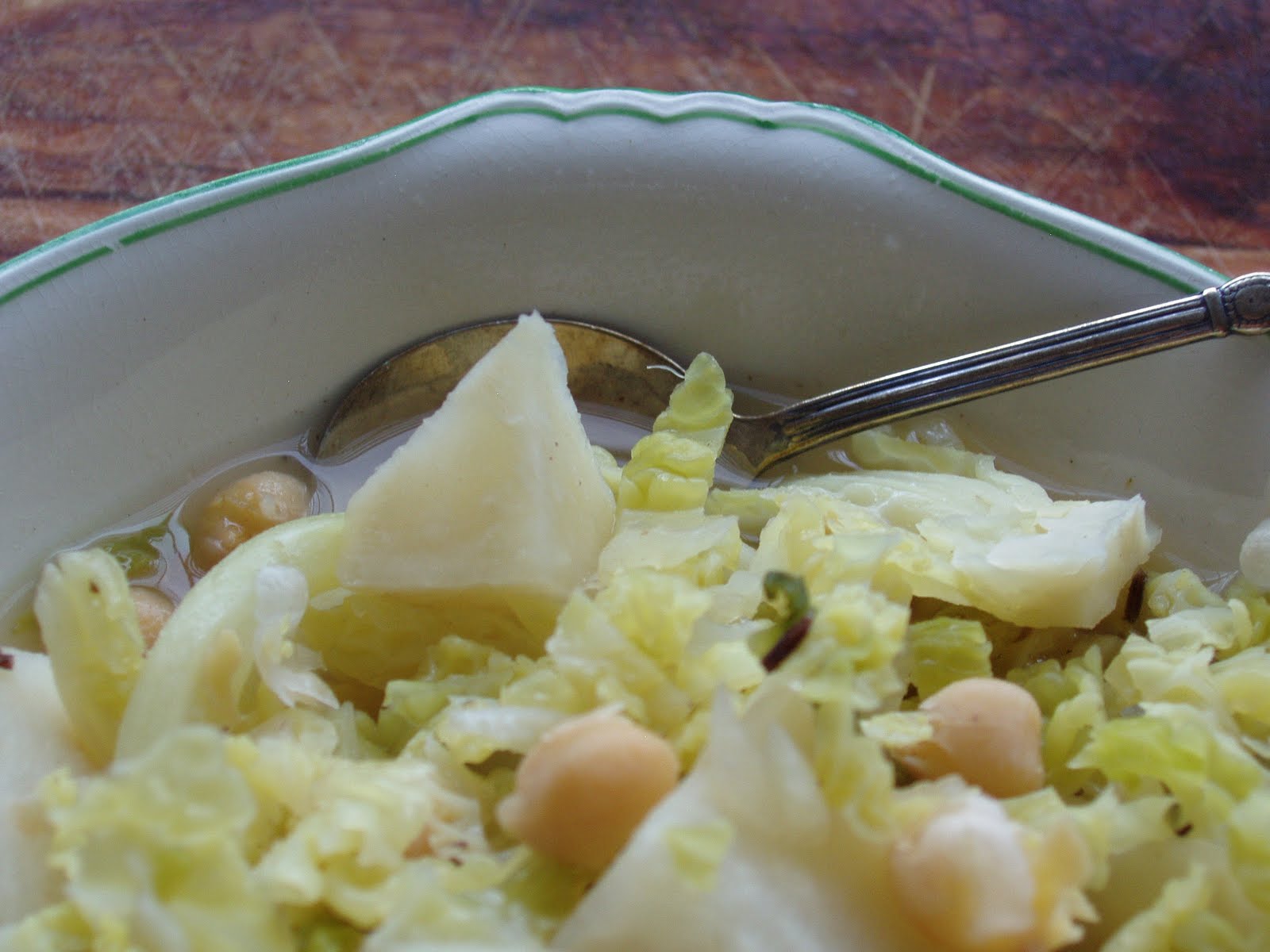
Celeriac, Chickpea and Cabbage Soup


I grew up gleaning food. We had different walks home from school depending whether it was the season for loquats, feijoas or cherry plums, or whether mum needed us to grab a few bay leaves. Even now, thirty years later, I still get an enormous kick out of finding food in public spaces; it's an even bigger kick in a built-up suburb like Brunswick.

This week, I've nipped bay leaves off a hedge a few blocks away; fennel seeds from an empty lot near the railway line; and parsley from garden escapees in the lanes near our house. It may not be enough to knit body and soul together, but it is more than enough to flavour soup.

And while spring may have sprung, today it is cold again, and we are promised more delightfully wintry weather for the weekend. As much as I cherish the wintry weather, even I must admit that it won't last forever; the season for soup is drawing to a close. This cold snap may be soup's last hurrah for a while; and so soup is what I have made.

Yet again, I have used celeriac to flavour the soup. It seems to have snuck its way into everything this year, possibly because it has been cheaper than potatoes at the organic shop. Here, it features with cabbage and chickpeas, its soft clean flavour lending brightness to what otherwise might have a cabbage-y boarding-house tendency. The soup is flavoured with the herbal gleanings and homemade stock; it is very economical, yet absolutely delicious. A nice piece of sourdough on the side, and you have a complete meal.

Celeriac, Chickpea and Cabbage Soup

- 4 tbs olive oil
- 5 anchovies (optional)
- 2 bay leaves
- 2 tsp fennel seeds, crushed
- 1 brown onion, chopped
- 800g celeriac
- 200g dried chickpeas, soaked overnight then cooked until soft
- 400g Savoy cabbage, shredded
- 1 litre hot chicken stock (recipe here)
- salt, pepper
- parsley, chopped
- parmesan (optional)

Warm the olive oil in a large soup pot. Add the anchovies and push them around with a wooden spoon for a minute or two, or until they have turned to paste. Add the bay leaves and fennel seeds, and cook for another minute. Add the onion and celeriac, turn the heat down, and cook until soft.

Add the cooked chickpeas, the cabbage, and the chicken stock, and season. Cover and simmer for half an hour or until the celeriac is cooked through.

Check for seasoning, sprinkle with parsley, and pass the parmesan.

Simplified from a recipe in the fantastic River Cafe Cookbook Green.

(Local: celeriac, chickpeas, cabbage, bay leaves (nipped from an overhanging tree a few blocks away), fennel seeds (scrounged from the railway line), parsley (picked from a garden escapee in a laneway since our chickens got to ours), olive oil. Victorian: onions, salt. Various provenances which I can't be bothered to list: chicken stock ingredients, anchovies (sustainably fished). La bella Italia: parmesan.)


The River Cafe Cookbook Green

Thursday, May 26, 2011

Cabbage with Chestnuts and Apples


Somewhere deep within me is a German harrumphing to get out. Whenever the weather turns cold, my thoughts turn to pork sausages, apples, cabbage, potatoes and chestnuts. This is odd, because we don't usually cook meat at our house, and 40% of my household won't eat it.

But every now and then, my German genes erupt. My great grandfather Gunter was born in Australia to German immigrants. He was a stern and arrogant man who owned a butcher's shop, and was deeply offended when his daughter, Constance, married below her station; she wed Bill the apprentice. Grandfather Gunter did his best to make their marriage a misery, and I am told he largely succeeded. His own marriages were nothing to smile at, either. He wed three times, each time to a Mary; the first two Marys predeceased him. My grandmother was the daughter of the middle Mary.

Grandpa Gunter loved to save a penny. He knew every bend and dip in the road between Katanning, his home town in the West Australian wheat belt, and Perth; and would coast for miles to save on fuel. He put the money he saved into a big house on the riverbank in Perth, and towards his annual holiday to Melbourne to watch the Cup.

And that's about all I know. It's not much of a heritage to go on, but it's enough – enough, at least, to justify the fact that every now and then I absolutely must grill sausages (pork for 60% of the family, soy for the sorry 40%); mash a heap of potatoes; stew some apples; and fry up some cabbage in some sort of porky-Germanic-homage.

This week was one of those times. In the fridge was a lovely local Savoy cabbage and chestnuts from a friend's farm. Inspired by a variation on a red cabbage-and-apple-thingy in Stephanie Alexander's Cook's Companion, and a Brussels-sprouts-and-chestnut thingy we love from Nigella Lawson's Feast, I thought we could make a Savoy-cabbage-and-apple-and-chestnut-thingy of our own. So I sautéed half a small Savoy cabbage in butter until it was glossy, threw in a couple of handfuls of cooked chestnuts and a dash of apple cider vinegar; and when the chestnuts were warm I mixed through some chunky apple sauce. With mashed potatoes, a good pork sausage, and rain falling steadily outside, dinner, and life, was perfekt!

Cabbage with Chestnuts and Apples

- 300g fresh chestnuts in their shells, to make about 200g chestnut meats
- walnut sized lump of butter
- ½ small Savoy cabbage, shredded
- 1 tbs apple cider vinegar, or, for a nuttier flavour, dry sherry
- an apple, chopped and lightly stewed; or half a cup or so of chunky apple sauce

First, prepare the chestnuts (These instructions are taken straight from the recipe for Chestnut and Celeriac Soup; if you know how to do it, skip to the double asterisk(**).) (I usually prepare the chestnuts a night or two ahead, after dinner, and store the chestnut meats in the refrigerator until I am ready to cook them.) Hold a chestnut flat side down on a sturdy chopping board. Place the tip of a sharp knife at the top of the nut, and lever it downwards so that the nut is bisected from top to bottom, but the knife does not cut through the shell on the flat side. Place the chestnut into a bowl. When all the chestnuts have been treated thus, place the bowl of chestnuts into the freezer for ten minutes.

Bring a large pot of water to the boil. When the ten minutes is up, remove the chestnuts from the freezer and slide them into the rapidly boiling water. Boil for eight minutes, then turn the heat down low. Remove several chestnuts from the water with a slotted spoon, and quickly pop each nut half out of its shell and skin (or peel it). Continue until you have liberated all the nuts. Work fast, because as the nut cools the skin reattaches itself very firmly.

If one or two chestnuts will not easily relinquish the inner skin, just sacrifice a little chestnut and slice it off rather than send yourself batty trying to peel it. Now the chestnuts are ready, and here you can pause for a day or two to suck your scalded fingers and recover, or, bless your soul, continue.

**Warm a walnut sized knob of butter in a wide skillet. Add the cabbage and sauté briskly, stirring, until the cabbage goes glossy. Add a tablespoon or so of apple cider vinegar (or sherry), and cook until the liquid has reduced, mere seconds. Add the chestnuts and apple sauce, and warm through.

Very nice by itself or with potatoes, but for the ultimate experience, add a good pork sausage!

(Local: chestnuts, cabbage, apples, apple cider vinegar. Not always local: butter, sherry, salt.)

Monday, September 20, 2010

Cabbage and Apple Salad


Okay, so I am an apple freak. I eat them every day, in every way – but I haven't been to a doctor in years!

Cabbage and apple salad (what an American would call 'slaw') is lovely and bright. The cabbage, at times a self-effacing old thing ducking to the rear of the crisper, is here cheered up immensely by the juicy sweetness of the apples.

With its palate-cleansing properties, this salad goes well with the earthiness of lentils; or it would be a perfect match for pork.

Cabbage and Apple Salad (Slaw)

- 2 cups green cabbage, preferably Savoy, shredded
- 2 Granny Smith apples, or other large sharp variety
- 1 tsp mustard seeds
- ½ - 1 cup walnuts, chopped (I like it very nutty)
- the juice of a lemon
- ½ tsp Dijon mustard
- 1 tbs apple cider vinegar
- 2 tbs olive oil
- 1 tbs apple sauce (which you have conveniently canned; use the rest of the jar in apple cake)
- salt, pepper

Place the mustard, vinegar, olive oil, apple sauce, salt and pepper in a jar. Screw the lid on tightly, and shake until emulsified. Taste, and adjust ratios if necessary.

Shred the cabbage. Grate the apples, peel and all, or julienne them if you're feeling refined. Place the apple into a salad bowl, and squeeze the juice of a lemon over it. Toss. Add the cabbage and mustard seeds, and toss again. Drizzle the vinaigrette over the salad, and mix gently but well.

Sprinkle the walnuts over the top, and serve.

The original recipes included a bunch of radishes, shredded; but that would make it too peppery for my young family.

Adapted from a recipe in The Wednesday Chef, who adapted it in turn from a recipe by Jeremy Fox.

(Local: cabbage, apple, walnuts, lemon, apple cider vinegar, apple sauce, olive oil. Not local: mustard seeds, Dijon mustard, salt.)